Durable QSR Seating: Vinyl, Finishes and Cleaning Minutes (2026 Guide)
How to specify fast casual and QSR seating that survives constant cleaning: vinyl ratings, sanitizer compatibility, frames, bases and design details that cut cleaning time.
Short answer
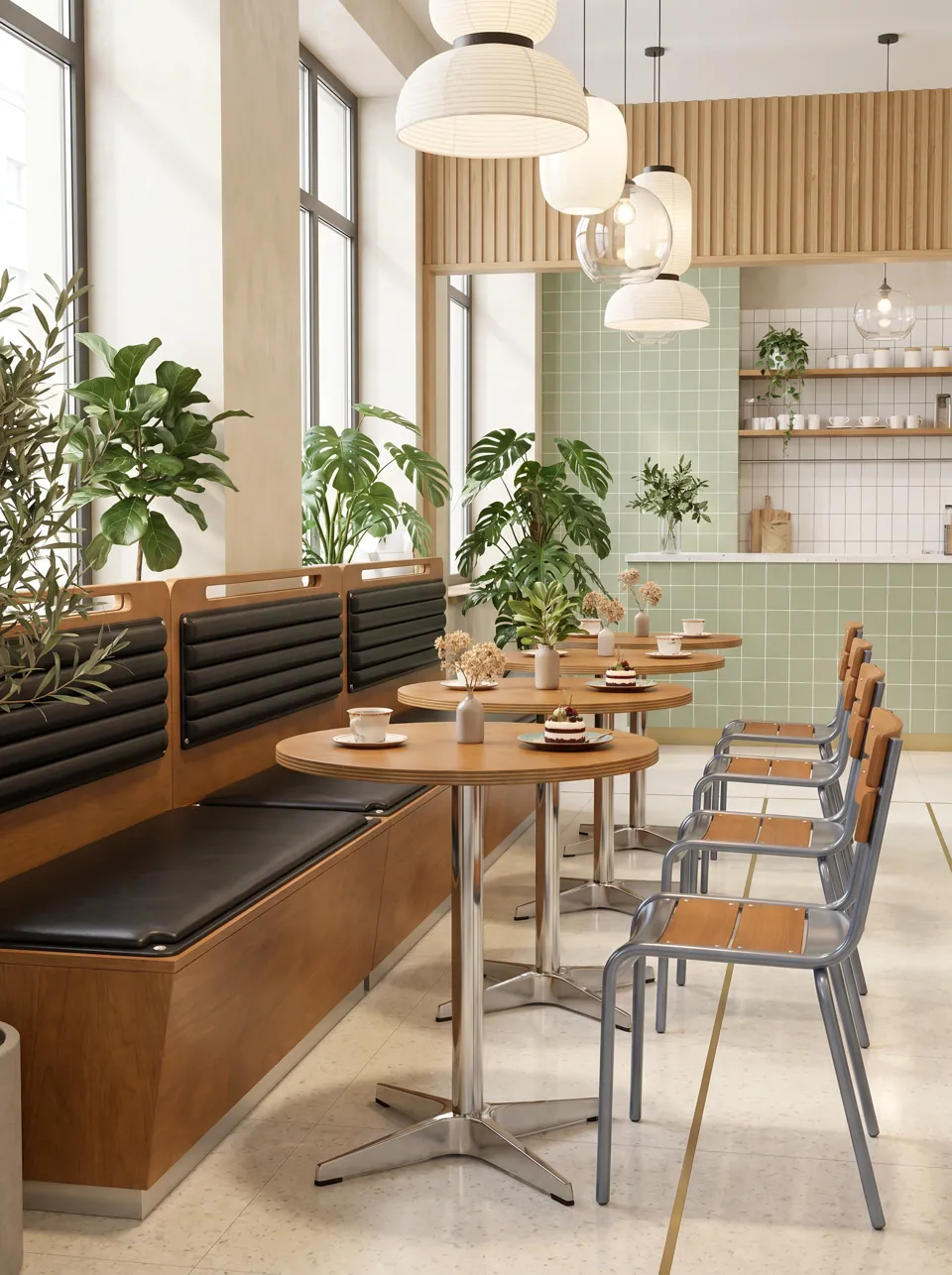
For quick-service seating, specify contract vinyl with a published cleaning guide (many contract vinyls test at 100,000+ Wyzenbeek double rubs), powder-coated steel or sealed hardwood frames, no buttons or deep tufting on seats, a crumb gap at the back of booth seats, removable cushions, and bases that keep upholstery clear of mop water. These details reduce cleaning minutes per table and turn repairs into part swaps.
This guide breaks down durability into the parts that actually wear, explains what to ask suppliers, and shows how small design choices save cleaning time across thousands of wipe-downs. It comes from QSR Seat, a line by EASEN Commercial Furniture.
Why does durability mean something different in quick service?
A quick-service seat is used far more often than a full-service one: shorter stays mean more sit-downs per seat per day, and every turn is followed by a wipe with sanitizer. A booth seat that sees dozens of guests a day and is wiped after each one takes years of residential use in months. The things that fail are predictable:
- Seat covers crack, split or lose color.
- Seams open where the cover is under tension.
- Foam softens and bottoms out.
- Finishes on frames chip or wear at contact points.
- Bases swell or delaminate from mop water.
- Glides wear through and legs scratch floors.
Design and specification can address every one of these.
Which upholstery is best for QSR booths and chairs?
Contract vinyl is the default for most quick-service seating, for good reasons: it wipes clean, resists liquids, and is available in almost any brand color. Not all vinyl is equal. Ask for:
| Property | What to ask for | Why |
|---|---|---|
| Abrasion | Wyzenbeek (ASTM D4157) result; 100,000+ double rubs is common for contract vinyl | Seats are rubbed on every sit-down |
| Cleaning guide | Published list of approved cleaners and dilutions | Confirms which sanitizers are safe |
| Bleach and disinfectant tolerance | Mill test or statement for your chemicals | Wrong chemicals crack or discolor some vinyls |
| Hydrolysis / aging resistance | For polyurethane-coated fabrics especially | Poor PU can peel within a few years |
| Cold crack | Low-temperature flexibility rating | Seats near doors in cold climates |
| Flammability | To your local requirement; CAL TB 117-2013 is widely referenced | Fire officials may ask for reports |
| Backing | Knit or woven backing suited to upholstery | Affects stretch, seam strength and tearing |
Woven fabrics have a place in slower cafe zones, but specify at least the ACT heavy-duty level (30,000 double rubs Wyzenbeek or 40,000 Martindale cycles), a W or W/S cleaning code, and a stain-resistant finish.
Will sanitizers damage restaurant seating?
They can, and this is the most common durability failure we see. Quaternary ammonium compounds, bleach solutions, alcohol and multi-purpose sanitizers all behave differently on vinyl, coatings and wood finishes. To avoid damage:
- Get the cleaning guide for the exact vinyl before ordering.
- Check your sanitizer against it, at the dilution your staff actually use.
- Rinse or wipe with clean water after strong disinfectants if the mill recommends it; residue build-up can harden or discolor vinyl.
- Avoid solvent cleaners on vinyl and on powder-coated or lacquered frames unless approved.
- Train staff to use the right cloth and dilution; over-strength mixes are the usual culprit.
We specify vinyls and finishes against the chemicals you name, so tell us your cleaning program when you request a quote.
Which design details cut cleaning minutes?
Cleaning time per table is set by how many surfaces, edges and crevices there are to wipe, and how easily the floor beneath can be mopped.
| Detail | Effect on cleaning |
|---|---|
| No buttons or deep tufting on seats | Nothing for crumbs and grease to pack into |
| Crumb gap between booth seat and back | Debris falls through instead of collecting in the crease |
| Flat or shallow channels on backs | One-pass wipe |
| Rounded corners | No tight seams at corners |
| Recessed or raised base | Mop reaches under; base face stays dry |
| Wall-hung or cantilever tables | No table base to mop around |
| Light chairs | Faster to lift and move for floor cleaning |
| Removable cushions | Deep-clean or swap off-site |
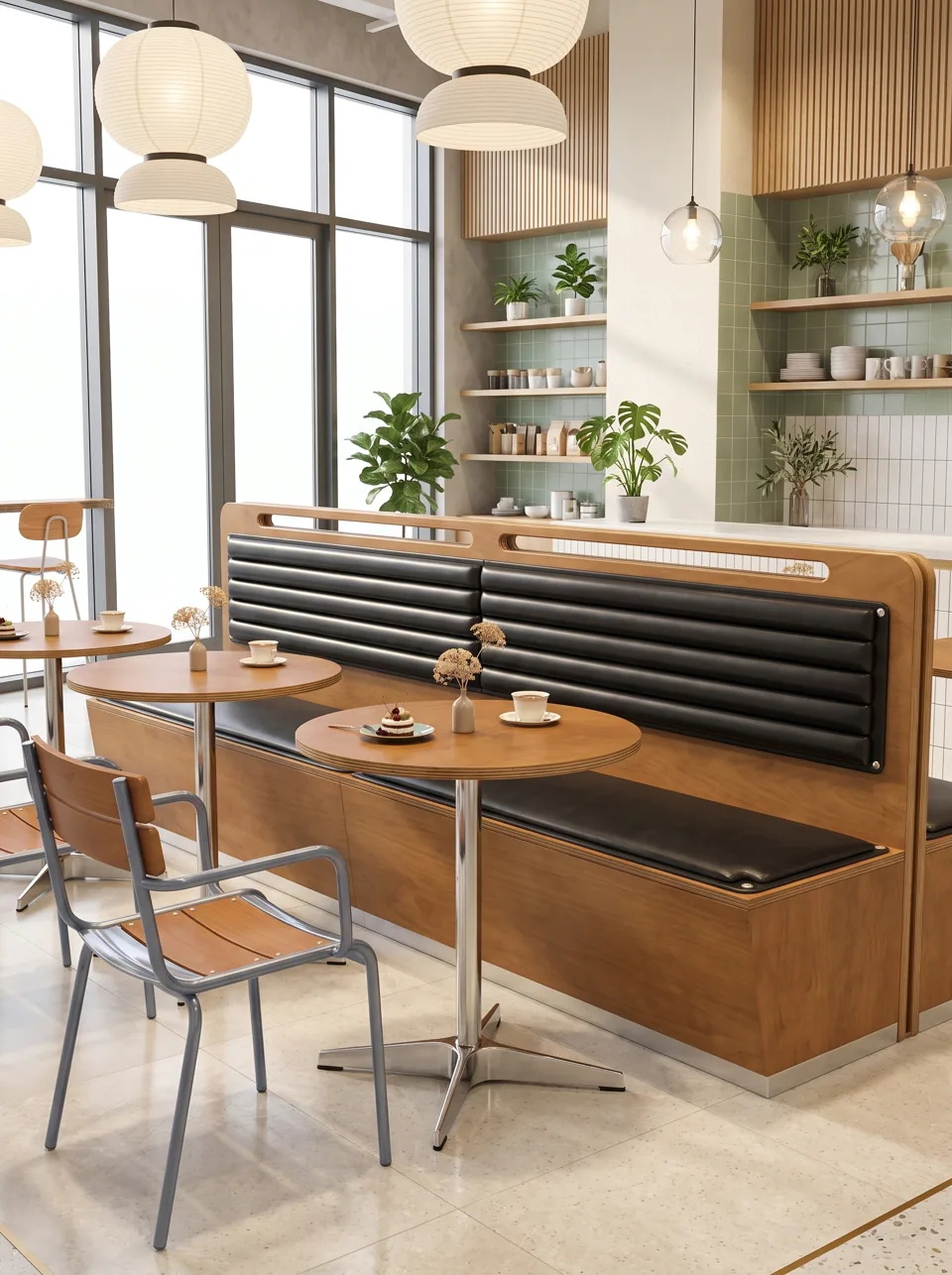
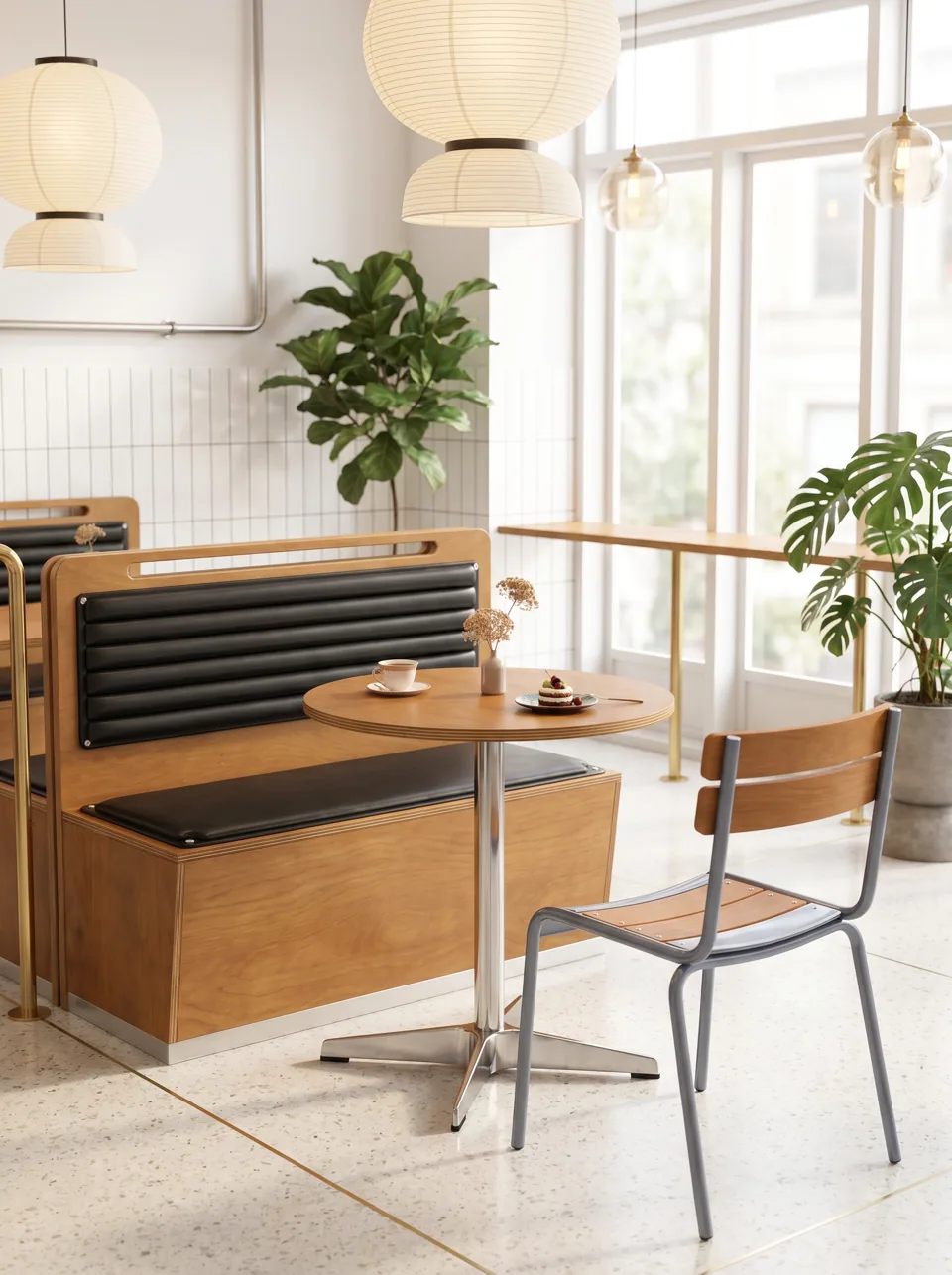
Our Zero-Leg Cantilever Booth takes the table base off the floor entirely, and the Diner Biscuit Booth gives the classic diner look without buttons.
What frame and base construction lasts in quick service?
Booth frames. Plywood and hardwood frames, glued and mechanically fastened, with the seat platform supported along its length rather than only at the ends. Ask what supports the seat and how the back is fixed to the seat box.
Booth bases. The base is the part that meets mop water every day. Options include:
- Recessed toe-kick bases that keep the upholstered face above the floor and back from the mop.
- Hardwood or laminate-faced bases that wipe clean and can be refinished.
- Raised bases on legs or rails for full mop access.
- Solid wood end panels in high-traffic aisles, like the Endguard Walnut-End Booth, which can be sanded and refinished rather than recovered.
Chair frames. Powder-coated steel is the most tolerant of cleaning chemicals and knocks; ask for pretreatment before powder coat so chips do not spread. Hardwood frames need a durable coating such as polyurethane or catalyzed lacquer, and joints that are glued and reinforced.
Glides. Nylon for tile and sealed concrete; PTFE or felt for wood. Replace worn glides before steel or wood meets the floor.
How do I lower replacement cost over the life of the seating?
Replacement cost depends less on the purchase price than on what you have to replace when something fails.
- Specify removable cushions on booths, fixed with screws, snaps or zips.
- Order spare covers or cushions: roughly 10% of booth seats, from the same production lot.
- Order spare chairs: 5-10% per model, minimum two.
- Use replaceable panels for parts that take impacts, such as ends and outer backs.
- Keep the drawings and specs on file so replacements match.
- Standardize across locations so one spare stock serves several units.
The Zip-Swap Booth is built around steps 1 and 2.
Checklist: durability spec for a QSR seating package
- Vinyl abrasion result and method stated.
- Vinyl cleaning guide checked against your sanitizer and dilution.
- Flammability to local requirement, with reports where available.
- No buttons or deep tufting on seats; crumb gap on booths.
- Removable booth cushions; spare covers ordered.
- Booth base detail keeps upholstery clear of mop water.
- Chair frames powder-coated steel or sealed hardwood, reinforced joints.
- Glides matched to floor; spares supplied.
- Drawings and finish specs archived for repeat orders.
Common mistakes
- Choosing vinyl by color card alone. Two vinyls of the same color can have very different durability and chemical resistance.
- Using unapproved sanitizers or over-strength dilutions.
- Button tufting on seats. It looks classic and cleans badly.
- Upholstery to the floor. Mop water wicks into the base and cover.
- No spares. One torn seat with no replacement looks bad for weeks.
- Mixing too many vinyls across locations, multiplying the spare stock you need.
FAQ
Can I use bleach on vinyl restaurant booths?
Many contract vinyls tolerate diluted bleach, but not all, and the safe dilution varies. Check the mill's cleaning guide for the exact vinyl, and rinse if recommended.
How many double rubs should QSR seating vinyl have?
Contract vinyls commonly test at 100,000 double rubs or more on the Wyzenbeek method. Treat the ACT heavy-duty guideline of 30,000 as an absolute floor for fabrics.
What is a crumb gap on a booth?
A small gap between the back of the booth seat and the bottom of the backrest, so crumbs fall through instead of packing into the crease. It shortens wipe-downs and keeps booths looking cleaner.
How long should restaurant booth upholstery last?
It depends on use, cleaning chemicals and cover quality. The practical goal is to make covers replaceable so their lifespan does not set the booth's lifespan. Warranty terms are set per project in your quote.
Send your floor plan, seat target and brand colors. We will reply with a marked-up layout, recommended pieces and a quote.
Request a quote